How to Reset a Tripped Circuit Breaker
Power out in part of your home? Here's how to safely reset a tripped circuit breaker in 30 seconds — and what to do if it keeps tripping.
By Askento Editorial Team · 10 min read · Apr 1, 2026
Written with AI assistance, grounded in cited sources and checked by automated quality gates. How we create our content

General information only. This article may include AI-assisted content. While we aim for accuracy, verify important details before acting on them. Affiliate disclosure: This page may contain affiliate links. We may earn a commission at no extra cost to you.
To reset a tripped breaker, switch off the appliances on that circuit, find the breaker sitting in the middle or OFF position, push it firmly all the way to OFF, then back to ON. If it trips again straight away, stop and read If It Trips Again Immediately.
A tripped breaker switch cuts power to part of your home — it's one of the most common household electrical issues. The circuit breaker trips as a safety feature, not a malfunction, and resetting it is usually simple and safe. This is the home base for household electrical questions — once your power's back on, the cluster links at the bottom cover outlets, switches, dimmers, fans, and safety detectors.
Why Breakers Trip
A circuit breaker trips when the electrical current in a circuit exceeds its rated capacity. This happens when:
- Too many appliances are running on the same circuit at once (the most common cause)
- A faulty appliance is drawing too much current
- A short circuit — wires touch that shouldn't
- A ground fault — electricity finds an unintended path to ground
The breaker trips to prevent overheating and fires. It's doing its job.
How to Find Your Electrical Panel
Your electrical panel (breaker box) is usually in:
- A utility room, basement, or garage
- A hallway closet
- On the side of your house (in an outdoor box)
It's a metal box with a door, usually grey or beige. Open it and you'll see rows of switches — those are your breakers.
In an Apartment
In most apartments, the panel for your unit is inside the unit — commonly in a hallway, a closet, the kitchen, or behind a door. Electrical codes generally require that occupants can reach the breakers serving their own unit, so it is rarely locked away in a basement.
Resetting a tripped breaker in your own panel is normal, and you don't need to wait for the landlord. Contact building maintenance instead if:
- you can't find a panel anywhere in your unit
- the breaker won't stay on after a reset
- your whole unit is dark but neighbours have power (the feed to your unit is controlled from a building panel you shouldn't open)
- you see scorch marks or smell burning at the panel or an outlet
How to Reset a Tripped Breaker Switch
Before touching the panel, verify power is off with a non-contact voltage tester — an inexpensive tool that beeps near live wires without touching them.
-
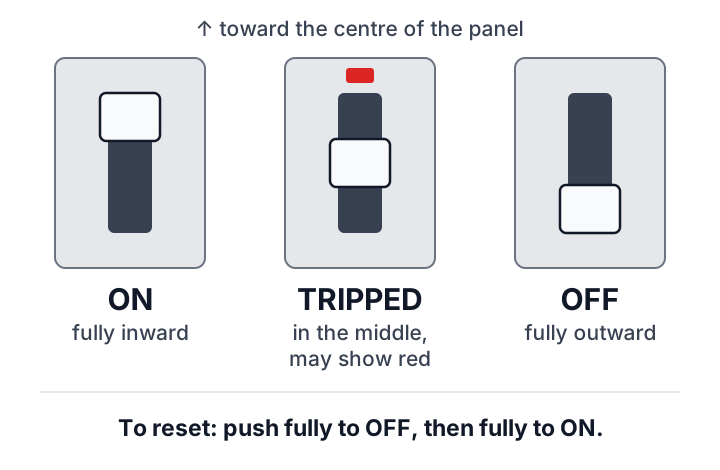
Identify the tripped breaker — it will be in the middle position (between ON and OFF), or fully in the OFF position. Some breakers have a red or orange indicator window that shows when tripped.
-
Turn off or unplug appliances in the affected area — before resetting, reduce the load on that circuit.
-
Firmly push the breaker to OFF — you must fully push it to the off position first before you can reset it. It should click.
-
Push it firmly to ON — it should click into place. Power should be restored.
-
Test the circuit — turn on one appliance at a time to identify if something is causing it to trip again.
What If No Breaker Looks Tripped?
Sometimes power is out to an area but every breaker looks like it's ON. A tripped breaker often only moves slightly to the middle, which is hard to see. Two things to try:
- Reset every breaker on that side anyway. Push each one firmly OFF, then ON. The small middle-position trip is easy to miss by eye.
- Check for a GFCI outlet first (see below) — a dead bathroom, kitchen, garage, or outdoor outlet is far more often a tripped GFCI than a panel breaker.
If the whole house is dark, first check whether neighbours have power. If they're out too, it's a utility outage and nothing in your panel will fix it. If they have power and you don't, check the main breaker.
Resetting the Main Breaker
The main breaker is the large switch, usually at the top of the panel, that controls power to the whole house. Its amp rating (commonly 100 or 200 on newer homes) is printed on the handle. Some homes have it in a separate outdoor box next to the electric meter instead.
- Turn off big loads first — the AC, electric heaters, the dryer and the oven. Restoring power to everything at once is what trips a main again.
- Push the main firmly to OFF, then firmly to ON. Like a branch breaker, a tripped main may sit in a middle position and needs the full OFF push before it will reset.
- Bring appliances back one at a time.
A main breaker that trips again is not something to keep resetting. It points to a serious overload or a fault, so call an electrician.
Breaker Types You Might See
Not every switch in the panel is a plain breaker:
- Standard breaker — the common single switch protecting one circuit.
- AFCI (arc-fault) — required in bedrooms and living areas in newer homes; trips on dangerous arcing. These have their own test button and can nuisance-trip on certain motors.
- GFCI breaker — combines panel protection with shock protection, used where a GFCI outlet isn't practical.
- Double-pole breaker — two switches joined together for 240-volt appliances (dryer, oven, AC). Both must be reset together.
Resetting a breaker with a TEST button. AFCI and GFCI breakers reset the same way as a standard breaker: handle fully to OFF, then ON. The TEST button only trips the breaker to prove the protection works; it doesn't reset it. If one trips again immediately, treat it like any breaker that won't hold (see below).
Got Fuses Instead of Breakers?
Older homes may have a fuse box — round screw-in (plug) fuses or cylindrical cartridge fuses — instead of breakers. A fuse can't be reset. When it blows, the metal strip inside melts, and the fuse has to be replaced.
- Spotting a blown plug fuse: look through the window on top. A broken metal strip or a blackened, cloudy window means it has blown.
- Replacing it: turn off the main (a main switch or a pull-out main fuse block), unscrew the blown fuse, and screw in a new one with exactly the same amp rating.
- Never fit a higher-rated fuse. The fuse is there to protect the wiring. An oversized fuse lets the wire overheat before anything cuts out — a real fire risk.
If new fuses keep blowing, the circuit is overloaded or faulty; that's a job for an electrician.
If It Trips Again Immediately
This is a sign of something more serious:
- Overloaded circuit: you have too many high-draw appliances on one circuit. Spread them across different outlets/circuits.
- Faulty appliance: unplug everything on that circuit and reset. Plug appliances back in one by one. When it trips, you've found the culprit.
- Short circuit or wiring problem: if the breaker trips with nothing plugged in, there may be a wiring fault. Stop resetting it and call an electrician.
When a Space Heater Keeps Tripping the Breaker
A plug-in space heater draws a lot of current for something that plugs into an ordinary outlet. Amps are watts divided by volts, so a heater drawing 1,500 watts on a standard 120-volt outlet pulls 12.5 amps by itself, and 6.25 amps on a 750-watt low setting. The number printed on the breaker's handle is its amp rating.
| Breaker | Heater on 1,500 W | Left for everything else on the circuit |
|---|---|---|
| 15 amps | 12.5 amps | 2.5 amps |
| 20 amps | 12.5 amps | 7.5 amps |
That is why the breaker often holds for a few minutes and then trips: the heater alone fits, but a lamp, a TV or a second appliance on the same circuit pushes the total over the rating.
- Turn it down. The low setting halves the current.
- Move it to another circuit. Outlets in one room often share a breaker with the next room. Switch the tripped breaker off and see which outlets go dead, then pick one that stays live.
- Plug it straight into the wall. The U.S. Consumer Product Safety Commission says to "plug electric space heaters directly into a wall outlet—never into an extension cord or power strip" (CPSC, January 2026).
- If it trips with the heater alone on the circuit, even on low, the heater or the wiring has a fault. Stop using it on that outlet and call an electrician.
What the heater costs to run is a separate question: see what a space heater costs per hour in every state.
GFCI Outlets — A Different Reset
In bathrooms, kitchens, garages, and outdoor areas, you may have GFCI outlets — they have two small buttons (TEST and RESET) in the center. These have their own built-in protection that trips independently of the main panel.
If outlets near water sources stop working, look for a nearby GFCI outlet and press the RESET button. One GFCI outlet often protects several regular outlets downstream.
When to Call an Electrician
- The breaker trips repeatedly for no obvious reason
- You smell burning near the panel
- The breaker feels hot to the touch
- You can see scorch marks around outlets or switches
- The panel is old (especially if it's a Federal Pacific or Zinsco panel — these have known safety issues)
Don't keep resetting a breaker that keeps tripping — that's the electrical system telling you something is wrong.
If the breaker throws a visible spark as you reset it, see breaker sparks when trying to reset for how to tell a normal arc from a wiring fault.
Home electrical hub
Power restored? These cover the rest of the common household electrical jobs:
Outlets, switches & dimmers
- How to replace an electrical outlet
- How to replace a light switch
- How to add a dimmer switch
- Can you add a dimmer switch to any light?
Ceiling fans & fixtures
- How to install a ceiling fan
- Can you replace a light with a ceiling fan?
- How to change a ceiling fan light fixture
- Can you replace a ceiling fan with a light fixture?
Safety detectors
Frequently Asked Questions
- How do I reset the main breaker?
- Switch off or unplug large appliances first (AC, electric heater, dryer, oven). Then push the main breaker, the large switch usually at the top of the panel, firmly to OFF and back to ON. Bring appliances back one at a time. If the main trips again, stop resetting it and call an electrician.
- Can you reset a blown fuse?
- No. A fuse can't be reset. When it blows, the metal strip inside melts and the fuse has to be replaced with a new one of exactly the same amp rating. Never fit a higher-rated fuse: the fuse protects the wiring, and an oversized one lets the wire overheat.
- How do I reset a breaker in an apartment?
- The panel for your unit is usually inside the apartment, in a hallway, closet, kitchen or behind a door. Reset it the same way as in a house: firmly OFF, then ON. Contact building maintenance if you can't find a panel, the breaker won't stay on, or the whole unit is dark while your neighbours have power.
- How do I reset a tripped circuit breaker?
- Find the breaker that's in the middle or OFF position, push it firmly all the way to OFF until it clicks, then push it firmly to ON. Reduce the load first by switching off appliances on that circuit. If it resets and holds, you're done; if it trips again immediately, stop and investigate.
- Why does my breaker keep tripping?
- Three common causes: an overloaded circuit (too many high-draw appliances at once), a faulty appliance pulling excess current, or a short/ground fault in the wiring. Unplug everything on the circuit and add devices back one at a time — if it trips with nothing plugged in, you have a wiring fault and need an electrician.
- Is it safe to reset a breaker myself?
- Yes — resetting a breaker is designed to be done by homeowners and is safe. What's not safe is repeatedly resetting a breaker that keeps tripping, or a panel that's hot, smells of burning, or shows scorch marks. Those are signs to stop and call an electrician.
- How do I reset a breaker that has a TEST button?
- A breaker with a TEST button in the panel is an AFCI or GFCI breaker. Reset it exactly like a standard breaker: push the handle firmly to OFF until it clicks, then back to ON. The TEST button doesn't reset anything. Pressing it trips the breaker on purpose to check that the protection works. If it trips again as soon as you reset it, something on that circuit is triggering it: unplug everything on the circuit and try once more, and call an electrician if it still won't hold.
- How long should I leave a breaker off before resetting it?
- There's no set waiting time. Push the handle fully to OFF until it clicks, then back to ON. If it tripped from an overload and won't latch, the thermal trip inside may still be warm: unplug whatever overloaded the circuit, wait a few minutes, and try again. Never hold the handle in the ON position or keep flipping it.
- How do I know which breaker to reset?
- Look for the handle that isn't lined up with the others. A tripped breaker usually sits in the middle position or fully at OFF, and some show a red or orange indicator. The directory on the panel door may also say which breaker serves which room. If nothing looks tripped, check for a tripped GFCI outlet near a sink, in the garage or outdoors.
- What's the difference between a breaker and a GFCI reset?
- A breaker in the main panel protects a whole circuit from overload. A GFCI outlet (with TEST/RESET buttons, found near water) protects against shock and trips independently. If outlets near a sink or outdoors go dead but the panel looks fine, press RESET on a nearby GFCI outlet.
- What does a blown circuit breaker look like?
- A tripped breaker sits in the middle position between ON and OFF, or is fully in the OFF position. Some breakers have a red or orange indicator window that shows when tripped. On a standard breaker without an indicator the middle position is subtle — look for the handle sitting slightly off-center compared to the breakers around it. Scorch marks on the breaker or the panel are a serious warning sign and mean stop and call an electrician.
- Why won't my breaker reset?
- A breaker that won't stay in the ON position, or won't reset at all, usually means the fault that tripped it is still present — an overloaded circuit, a faulty appliance still plugged in, or a short/ground fault in the wiring. Unplug everything on that circuit first and try again; if it still won't reset with nothing connected, stop and call an electrician instead of forcing it repeatedly.
- Why does my breaker trip immediately after I reset it?
- An instant re-trip — power drops the moment you flip it back on, before you've plugged anything in — points to a short circuit or ground fault in the wiring itself, not an overloaded circuit. Overloads usually take a few seconds or minutes of use to trip the breaker; an instant trip with nothing drawing power means stop resetting it and call an electrician.
- Why does my space heater keep tripping the breaker?
- A space heater on high is a big load on its own: at 1,500 watts on a 120-volt outlet it draws 12.5 amps. On a 15-amp circuit that leaves 2.5 amps for everything else plugged into the same circuit, so a second appliance tips it over. Switch the heater to its low setting, move it to an outlet on a different circuit, and plug it straight into the wall, not into an extension cord or power strip. If it trips with the heater alone on the circuit, stop using it and call an electrician.
- How do you know when a breaker is bad?
- Signs the breaker itself has failed, rather than the circuit: it won't stay in the ON position even with everything on that circuit unplugged, the switch feels loose or spongy instead of clicking firmly, it's warm or hot to the touch, or you see corrosion or scorch marks around it. A bad breaker needs to be replaced by a licensed electrician — don't keep forcing a switch that won't hold.
On this page
Browse topics